Quick Answer
Can you make buffalo sauce with ghee instead of butter?Yes, but ghee requires more technique than regular butter. The problem: ghee is clarified butter - the milk proteins and water have been removed, leaving nearly pure milk fat. These milk proteins (particularly casein) and the water content of regular butter are the primary emulsifying agents in traditional buffalo sauce. Without them, ghee won't naturally emulsify with hot sauce the way butter does. The solution: add 1/4 teaspoon of sunflower lecithin per cup of sauce (a plant-based emulsifier that replaces the milk protein function), and use lower temperature than with regular butter. The result is a richer, nuttier buffalo sauce with a higher smoke point.
Why Ghee Is Harder to Emulsify Than Butter
Regular butter is approximately 80% fat, 18% water, and 2% milk proteins (casein and whey proteins). This composition makes it naturally suited for emulsification:
- The water phase integrates with the aqueous hot sauce
- Casein proteins are natural emulsifiers - they have hydrophilic (water-attracting) and hydrophobic (fat-attracting) regions that stabilize the fat-water interface
- The gradual melting of cold butter releases fat droplets slowly into the hot sauce, giving them time to distribute evenly
Ghee is approximately 99.9% pure milk fat - the water and proteins have been simmered off during clarification. When you add ghee to hot sauce, several things happen differently:
- No water phase: the ghee doesn't contribute aqueous phase for integration
- No emulsifying proteins: without casein, the fat droplets lack the natural molecular coatings that help them stay suspended in the hot sauce
- Ghee is liquid at room temperature (melting point ~93°F): cold ghee isn't solid the same way cold butter is - the "cold butter" technique that works by gradual fat release doesn't apply the same way
The result: adding ghee directly to hot sauce produces a separated sauce where the golden ghee pools on top rather than forming a stable emulsion.
The Lecithin Solution
Lecithin is a phospholipid - a type of molecule with a fat-soluble tail and a water-soluble head. This dual character makes it an ideal emulsifier: it sits at the fat-water interface in an emulsion and stabilizes it by coating fat droplets and preventing them from coalescing.
Adding sunflower lecithin (or soy lecithin) to the hot sauce before adding ghee provides the emulsification assistance that ghee lacks:
- Amount: 1/4 teaspoon sunflower lecithin powder per cup of finished sauce
- When to add: Add to the warm hot sauce and whisk thoroughly before adding any ghee
- Effect: The lecithin distributes through the hot sauce and pre-conditions it to receive fat droplets - when ghee is added, the lecithin molecules immediately coat the fat droplets and stabilize them
- Flavor impact: None - sunflower lecithin is flavor-neutral at these amounts
Lecithin is available in health food stores and online (supplement section - it's commonly sold for cognitive health purposes). Granular form blends more easily than waxy chunks.
The Full Ghee Buffalo Sauce Technique
- Measure 1/2 cup hot sauce into a small saucepan. Add 1/4 teaspoon sunflower lecithin.
- Whisk thoroughly until lecithin is fully dispersed - no visible granules. The hot sauce may look slightly foamy; this is normal.
- Warm over very low heat to 140-150°F (lower than the standard 160°F for regular butter - ghee emulsifies better at slightly lower temperature).
- Measure 4 tablespoons of ghee in a separate small container. Ghee is liquid at temperatures above ~93°F - it will likely be liquid at room temperature. If solid, allow to liquefy slightly but keep it cool.
- Add ghee to the hot sauce in a thin, slow stream while whisking vigorously. Add over 30-45 seconds rather than all at once.
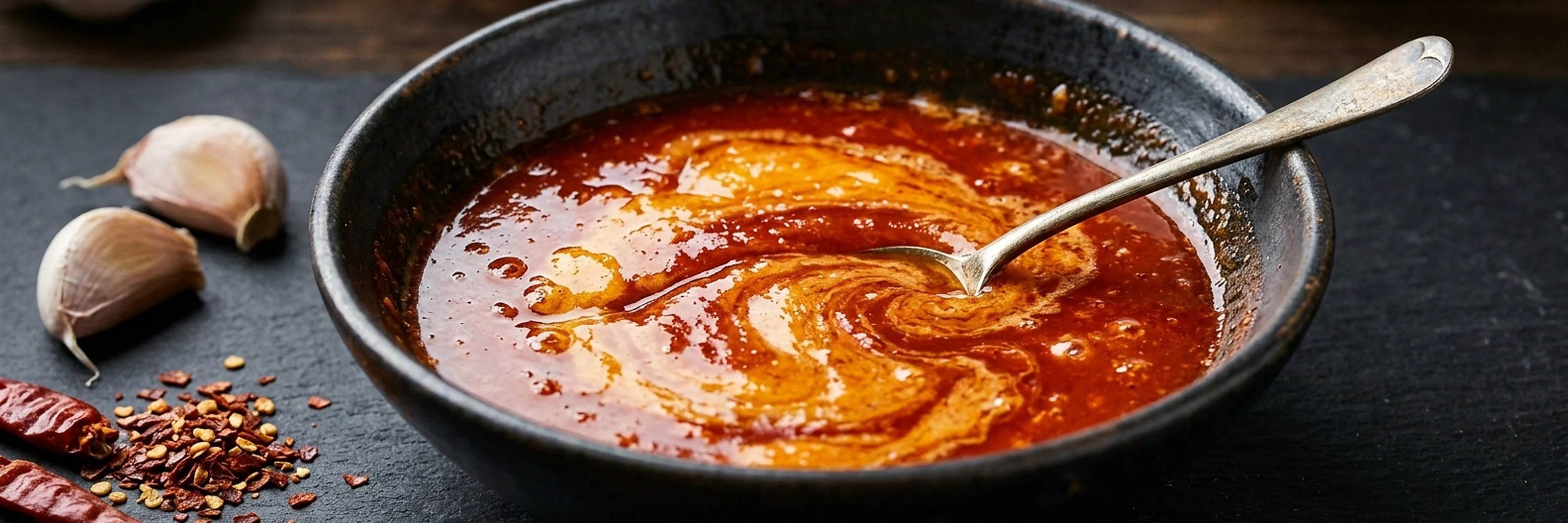
- The sauce should emulsify into a cohesive, glossy mixture. If it looks separated or oily: continue whisking and add another 1/4 teaspoon of lecithin dissolved in 1 tablespoon of water.
- Remove from heat immediately once emulsified. Serve promptly.
Temperature Sensitivity with Ghee
Ghee-based buffalo sauce is more temperature-sensitive than regular butter-based sauce. At temperatures above 175°F, ghee separates from the emulsion more readily than butter - the pure fat doesn't have milk proteins to help maintain stability at high temperatures. Serve immediately after making. If you need to hold ghee buffalo sauce warm: keep it at 130-140°F maximum (below the separation temperature). Re-emulsification after breaking is possible but requires re-adding lecithin. This is the main practical limitation of ghee buffalo sauce: it requires more care in service than butter-based sauce.
What Ghee Does to Flavor
Despite the technical challenges, ghee buffalo sauce has genuine flavor advantages:
- Richer, nuttier character: During clarification, the milk solids brown slightly (Maillard reaction), creating a nutty, slightly caramel-like flavor that regular butter doesn't have. This depth carries through to the buffalo sauce, adding a dimension that butter can't provide.
- Higher smoke point: Ghee's smoke point (~485°F) is significantly higher than butter (~350°F). For high-heat applications (broiling wings, very high-temperature pan saucing), ghee buffalo sauce won't burn the way butter buffalo sauce can.
- Dairy-free friendly: Properly made ghee contains essentially no milk proteins (casein and whey are removed during clarification) and very minimal lactose. Many people with dairy sensitivities tolerate ghee when they cannot tolerate regular butter. This makes ghee buffalo sauce a practical option for dairy-sensitive guests who still eat animal products.
- Longer stability at room temperature: Pure milk fat (ghee) is more stable than butterfat containing moisture and proteins - ghee buffalo sauce holds at room temperature slightly longer than regular butter buffalo sauce before the fat separates.