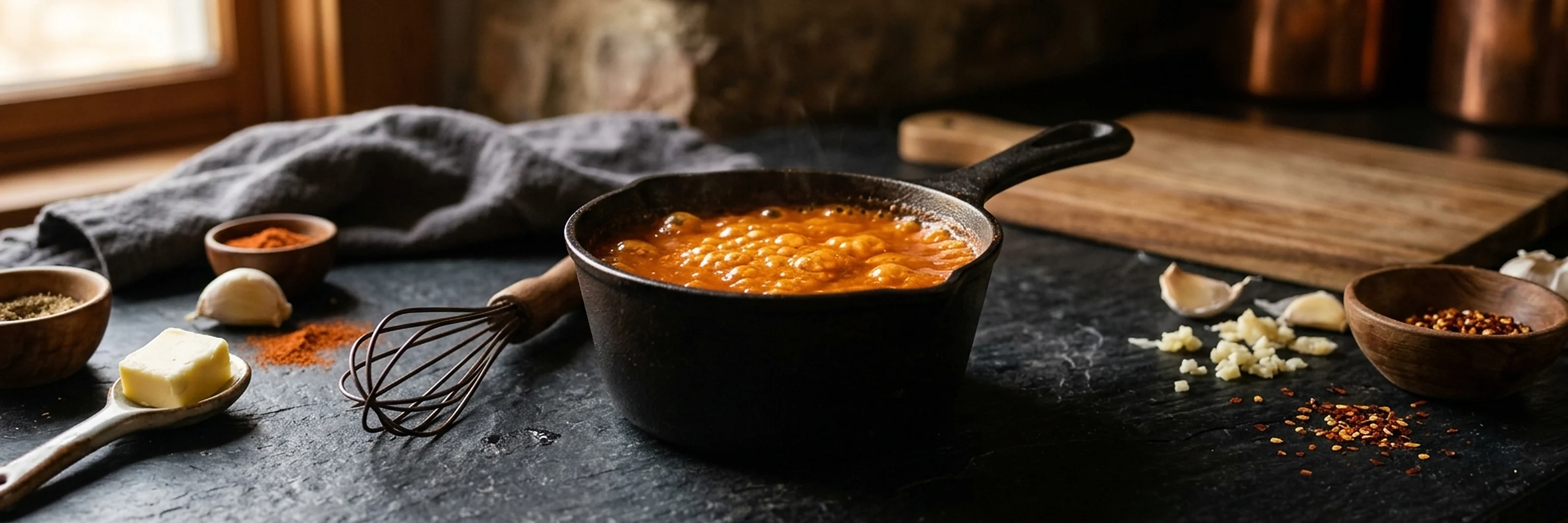
Quick Answer
How do you make low sodium buffalo sauce?Use a low-sodium hot sauce (Tabasco Reduced Sodium has 25mg per tsp vs. Frank's 190mg) as the base, unsalted butter, and add acid (extra vinegar or lemon juice) and umami (Worcestershire sauce, garlic) to compensate for reduced salt's flavor-flattening effect. A properly built low-sodium buffalo sauce can come in under 100-150mg sodium per 2-tablespoon serving compared to 400-500mg for standard buffalo sauce. The key challenge isn't eliminating salt entirely - it's replacing the flavor work that salt does: seasoning amplification, acid enhancement, and savory depth. Acid and umami fill those roles effectively.
The Sodium Problem in Standard Buffalo Sauce
Standard buffalo sauce is high in sodium because both main ingredients - hot sauce and butter - carry significant salt:
- Frank's RedHot Original: 190mg sodium per teaspoon. A standard buffalo sauce recipe uses 1/2 cup (24 teaspoons) of Frank's, contributing approximately 4,560mg sodium to the batch before adding butter or salt.
- Salted butter: approximately 90mg sodium per tablespoon. Standard recipes use 3-4 tablespoons, adding another 270-360mg.
- A 2-tablespoon serving of standard buffalo sauce has approximately 400-500mg sodium - roughly 20-25% of the American Heart Association's recommended daily limit.
For people managing sodium intake for cardiovascular health, hypertension, or kidney conditions, this creates a real problem: buffalo sauce is one of the higher-sodium condiments. A portion of wings with standard buffalo sauce at a restaurant can easily hit 1,500-2,000mg sodium in the sauce alone.
The good news: you can build a genuinely flavorful low-sodium buffalo sauce that captures the tangy, spicy character of the original. See the complete buffalo sauce nutrition breakdown for full nutritional comparisons across brands and homemade variations.
Low-Sodium Hot Sauce Options
Hot Sauce Sodium Content Comparison
| Hot Sauce | Sodium Per Tsp | Flavor Profile | As Buffalo Base? |
|---|---|---|---|
| Frank's RedHot Original | 190mg | Classic tangy cayenne | Standard - high sodium |
| Best: Tabasco Reduced Sodium | 25mg | Slightly mellower, still tangy | Best choice - 87% less sodium |
| Cholula Original | 95mg | Mild, slightly sweet | Good - 50% less sodium |
| Valentina Extra Hot | 64mg | Tangy, slightly sweet | Good - 66% less sodium |
| Tabasco Original | 35mg | Sharp, vinegar-forward | Excellent - low sodium, intense |
| Homemade fresh cayenne | ~5mg | Fresh, bright heat | Best for ultra-low sodium |
Tabasco Reduced Sodium is the closest to a drop-in replacement for Frank's in a low-sodium buffalo sauce. It has the same cayenne-forward heat profile, nearly identical vinegar tanginess, and comes in at 25mg sodium per teaspoon versus Frank's 190mg. Switching from Frank's to Tabasco Reduced Sodium alone reduces the sodium by approximately 87%.
Regular Tabasco Original is also an excellent low-sodium option at 35mg per teaspoon - it's more intense and vinegar-forward than Frank's, but this can be mitigated by using slightly less and adding a small amount of water or extra butter.
How to Compensate for Reduced Salt
Salt does multiple jobs in food beyond just "salty taste." When you reduce sodium, you need to address what salt was accomplishing:
- Salt enhances other flavors: Salt suppresses bitterness and amplifies sweetness and umami perception. Without adequate salt, sauces can taste flat or harsh. Compensate with umami-rich additions: Worcestershire sauce (low-sodium versions exist), a small amount of soy sauce (or coconut aminos, which have less sodium), or a half-teaspoon of nutritional yeast.
- Salt brightens acid: Salt makes acidic foods taste more vibrant. Without it, vinegar-forward sauces can taste sharp and one-dimensional. Compensate by adding fresh lemon juice (acid + bright citrus flavor) and white wine vinegar (cleaner acid than distilled).
- Salt rounds harshness: Salt rounds off sharp, harsh notes. Without salt, cayenne can taste rawer and more biting. Compensate by blooming the cayenne briefly (add a pinch of cayenne to warm butter before adding hot sauce - the fat and heat mellow the raw harshness).
- Garlic and onion amplification: Fresh or roasted garlic adds savory depth that partially compensates for reduced salt. Use real garlic (not garlic powder) and sauté it briefly in the butter before adding the hot sauce.
Ingredients
- 1/2 cup Tabasco Reduced Sodium hot sauce (or regular Tabasco for more heat)
- 3 tablespoons unsalted butter
- 1 tablespoon fresh lemon juice
- 1 teaspoon low-sodium Worcestershire sauce
- 1/2 teaspoon white wine vinegar
- 1 small clove garlic, minced (or 1/4 tsp garlic powder)
- 1/4 teaspoon smoked paprika
- Pinch of cayenne pepper (optional, for extra heat)
Method
- In a small saucepan over medium-low heat, melt butter. Add minced garlic and cook 1-2 minutes until fragrant but not browned.
- Add Tabasco Reduced Sodium and stir to combine. Bring to a very gentle simmer over low heat.
- Add lemon juice, Worcestershire, white wine vinegar, and smoked paprika. Stir to combine.
- Simmer on very low heat 3-4 minutes, stirring frequently, until sauce is slightly thickened and flavors are integrated.
- Taste and adjust. If it tastes flat: add a few more drops of lemon juice. If too sharp: add a small additional pat of butter. If not enough heat: add pinch of cayenne.
- Use immediately or refrigerate in a sealed jar for up to 1 week.
Tips
- For ultra-low sodium (under 50mg per serving): make your own hot sauce base from fresh cayenne peppers, white wine vinegar, and no salt. This is more involved but eliminates nearly all sodium from the hot sauce component.
- Coconut aminos (1/2 teaspoon) can replace Worcestershire sauce for an even lower-sodium option. It has about 90mg per teaspoon vs. standard Worcestershire's 65mg per tsp - similar, but coconut aminos are often cited as more flavorful per unit of sodium.
- This recipe has approximately 150mg sodium per 2-tablespoon serving, compared to 400-500mg for standard buffalo sauce. Three servings of this low-sodium version has less sodium than one serving of standard.
The Lemon Juice Strategy
The most effective single change to maintain flavor with reduced sodium is adding fresh lemon juice. Lemon juice provides both acid (which brightens flavor the way salt does) and a citrus aromatic note that makes the sauce seem more vibrant and complex. It's not a salt replacement - nothing perfectly replaces salt - but it fills the "flavor brightness" role that salt performs. Use 1 tablespoon of fresh lemon juice per 1/2 cup of hot sauce. Don't use bottled lemon juice - the fresh version has essential oils from the zest that bottled lacks.