Quick Answer
What are the main regional wing styles in the United States?The original Buffalo, NY style (Anchor Bar lineage) uses deep-fried whole wings tossed in Frank's RedHot + butter, served with celery and blue cheese dressing - no substitutions. From this base, regional variations developed: Nashville-style with dry rubs and hotter preparations; the dry-rub Memphis/Southern style (smoke and spice without sauce); the Korean-American style (twice-fried with sweet soy glaze or gochujang); and the national chain style (enormous portions, extensive sauce menu). Each regional style prioritizes different elements: the original prioritizes tangy sauce balance; Southern styles emphasize smoke and spice; Korean-American style prioritizes crispiness and glaze.
Buffalo, New York: The Source
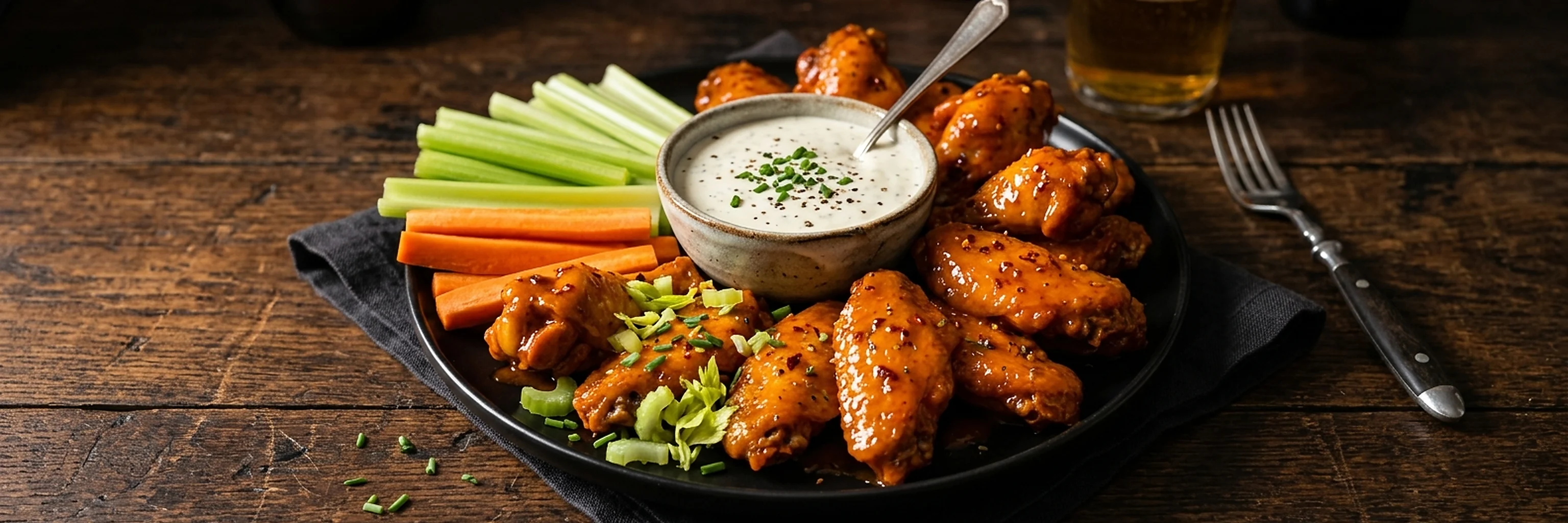
The Buffalo wing originated at the Anchor Bar in Buffalo, New York in 1964, when Teressa Bellissimo reportedly improvised a late-night snack by deep-frying whole chicken wings and tossing them in a combination of Frank's RedHot and butter. The defining characteristics of authentic Buffalo-style wings:
- Deep-fried: No baking, no air frying in the original. The wing is fried at high temperature until crispy, then immediately tossed in sauce.
- Whole wing sections: Drummettes and flats. The wing tip is typically discarded. In Buffalo, joints aren't cut into individual pieces - the flat and drumette may be together or separated depending on the establishment.
- Frank's RedHot + butter: The sauce is specifically Frank's RedHot (a cayenne-vinegar sauce made in Buffalo) emulsified with butter. No garlic, no honey, no additional spice. The simplicity is the point.
- Celery and blue cheese: Non-negotiable. In Buffalo, asking for ranch dressing with your wings is considered a cultural faux pas. Blue cheese - specifically a chunky, homemade-style blue cheese - is the correct accompaniment. Celery sticks are included automatically.
- Heat levels: Mild, medium, hot, and "suicidal" are standard options - achieved by varying the ratio of hot sauce to butter, not by adding different peppers. More sauce = hotter; more butter = milder.
The Blue Cheese Orthodoxy in Buffalo
The insistence on blue cheese over ranch dressing in Buffalo is genuine and deeply held. Buffalo establishments that offer ranch typically call it out separately, and locals are protective of the blue cheese pairing. The rationale has historical and culinary grounding: blue cheese's pungent, fatty, dairy-rich character specifically complements the tangy, vinegary heat of authentic Buffalo sauce in a way that the milder, herb-forward ranch does not match. Ranch became dominant nationally largely through chain restaurants that wanted a more universally appealing dip. For the authentic Buffalo experience, see the guide to the best dips for buffalo wings.
How National Chains Transformed Wings
The expansion of wing culture nationally - driven primarily by Buffalo Wild Wings (founded 1982 in Columbus, Ohio), Hooters (1983), and later Wingstop (1994) - transformed wings from a Buffalo regional specialty into an American staple. In the process, several things changed:
- Sauce variety explosion: Where Buffalo has maybe 3-4 heat levels of the same sauce, national chains built menus around dozens of flavors - mango habanero, honey garlic, parmesan garlic, Asian zing, lemon pepper. The wing became a canvas for any sauce rather than a specific dish with specific sauce.
- Ranch replaced blue cheese: Ranch dressing, more universally palatable than blue cheese, became the national default dip. Many people who grew up eating wings at national chains consider ranch the "normal" dip and have never tried the original blue cheese pairing.
- Boneless wings emerged: A significant departure - boneless "wings" are typically breaded chunks of chicken breast, not wings at all. They appeal to people who want the sauce experience without the messiness of bone-in wings. Many wing establishments now sell more boneless than bone-in.
- Wing sizes grew: Commercial wing operations use significantly larger wings (16-18 pieces per pound) than the original tradition. The larger size affects sauce-to-meat ratio and cooking time. See the wing sizes guide for details.
Distinct Regional Wing Styles
Beyond the national chain homogenization, several genuine regional wing cultures have developed:
- Nashville Hot Wings: Drawing from the Nashville hot chicken tradition (cayenne paste fried into the oil, then brushed with cayenne-spice-sugar paste after frying), Nashville-style wings have a dry, spiced crust rather than a wet sauce. The heat comes from paste rather than liquid - different capsaicin delivery. Typically served with pickles and white bread to moderate heat. The dry finish is fundamentally different from the wet, sauced Buffalo approach.
- Memphis / Southern Dry Rub Wings: The Memphis BBQ tradition of dry rub over wet sauce applies to wings as well. Memphis dry rub wings are seasoned before and after frying with a spice blend (paprika, garlic, cumin, cayenne, brown sugar). No sauce is applied - the crust is the seasoning. These are eaten without dipping sauce at many Memphis establishments.
- Korean-American Wings (KFC - Korean Fried Chicken): Popularized by Korean-American restaurants, twice-fried wings (fried, rested, fried again at higher temperature) with a sweet-spicy glaze - typically a soy-based sauce with gochujang, garlic, and honey, or a sweet soy (yangnyeom) glaze. The double-fry creates an exceptionally thin, glassy crust. Often served with pickled daikon instead of celery.
- Detroit Lemon Pepper: Detroit has developed a distinct lemon pepper wing culture where wings are tossed in a mixture of lemon pepper seasoning and butter (sometimes with added hot sauce) - related to but distinct from Buffalo sauce. "Lemon pepper wet" (with butter) vs. "lemon pepper dry" (seasoning only) is a significant local distinction.
- Atlanta Lemon Pepper: Similar to Detroit but with its own distinct character. Atlanta's wing scene is significant enough that lemon pepper wet has become a nationally recognized wing variation. The sauce is typically applied after frying: melted butter with lemon pepper, brushed or tossed.
Regional Styles Compared
American Regional Wing Style Comparison
| Style | Heat Delivery | Sauce/Seasoning | Classic Dip | Origin |
|---|---|---|---|---|
| Best: Buffalo Original | Liquid cayenne sauce | Frank's RedHot + butter | Blue cheese | Buffalo, NY (1964) |
| Nashville Hot | Paste fried into oil | Cayenne paste, sugar | None (pickles) | Nashville, TN |
| Memphis Dry Rub | Spice rub | Dry paprika/cayenne blend | None or BBQ sauce | Memphis, TN |
| Korean (KFC) | Gochujang/sweet soy glaze | Twice-fried, glazed | Pickled daikon | Korean-American communities |
| Detroit Lemon Pepper | Black pepper + citrus | Lemon pepper + butter | Ranch | Detroit, MI |
| Atlanta Lemon Pepper Wet | Mild, butter-forward | Lemon pepper + butter sauce | Ranch | Atlanta, GA |
| National Chain Style | Varies by sauce choice | Multi-sauce menu | Ranch (default) | National, 1980s - present |