Quick Answer
Which hot sauce brand is the oldest and most historically significant?Tabasco, made by McIlhenny Co. on Avery Island, Louisiana, is the oldest major American hot sauce brand, first sold commercially in 1868. It established the cayenne pepper + vinegar formula that defines American hot sauce. Frank's RedHot, founded in 1920 in Louisiana and originally sold as a cayenne condiment, became the most culturally significant wing sauce when it was used to make the first buffalo wings at the Anchor Bar in Buffalo, NY in 1964. Louisiana Hot Sauce (Trappey's, Crystal, Louisiana Brand) represents the distinct Louisiana-style - thinner, less acidic, more pepper-forward than Tabasco.
Tabasco: The Foundation (1868)
Edmund McIlhenny was not a pepper farmer - he was a banker who had taken refuge on his father-in-law's Avery Island estate after the Civil War destroyed his New Orleans business. His signature creation came from Tabasco peppers (capsicum frutescens) he'd grown as a curiosity, fermented in salt, aged in wooden barrels, and mixed with vinegar. McIlhenny's 1868 formulation established the three-ingredient template that defined American hot sauce: peppers, vinegar, salt.
The Tabasco manufacturing process is still centered on Avery Island. The peppers are fermented in white oak barrels (the same barrels used for Tabasco sauce for over 150 years) for three years before mashing and blending with white wine vinegar. This aging creates the sauce's characteristic complexity - what seems like a simple product has undergone years of fermentation.
Tabasco's pH hovers around 3.0 - significantly more acidic than most other hot sauces. This acidity and its relatively thin consistency made Tabasco more of a cooking condiment (dashes in Bloody Marys, cocktail sauce, oysters) than a wing sauce. Wings require a sauce thick enough to coat and adhere; Tabasco is too thin and too sour to make an effective wing sauce without significant modification (lots of butter).
Frank's RedHot: The Wing Standard (1920)
Frank's RedHot was created in 1920 by the Estilette family in Louisiana, using cayenne peppers grown locally. The formulation - aged cayenne peppers, distilled white vinegar, garlic powder, water - was purchased by Durkee Famous Foods in 1977 and later by Reckitt Benckiser (now part of McCormick). Throughout these ownership changes, the formulation remained essentially unchanged.
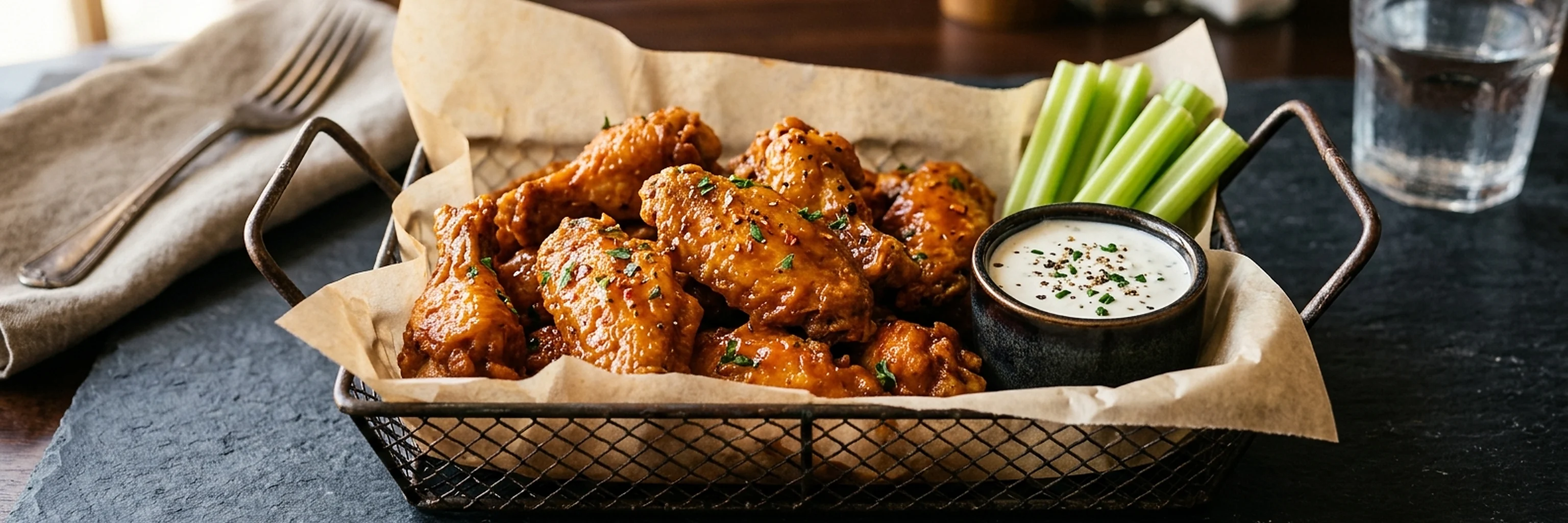
The critical historical moment for Frank's: Teressa Bellissimo at the Anchor Bar in Buffalo, NY, used Frank's RedHot as the base for her now-legendary buffalo wings in 1964. The exact details of that night are disputed (several family members give different accounts), but the core fact is documented: Bellissimo combined Frank's RedHot with butter and tossed fried chicken wings in the mixture. The combination was immediately popular and spread from Buffalo to national consciousness through the 1970s and 80s. Frank's RedHot became permanently associated with wings.
In 1995, Durkee released "Frank's RedHot Buffalo Wing Sauce" - a pre-made combination of Frank's and butter in a bottle. This product canonized the recipe and made buffalo wing sauce accessible to home cooks who previously had to make their own emulsion. It also accelerated the mass market's awareness of buffalo sauce as a distinct category, separate from hot sauce.
Louisiana-Style Hot Sauces
"Louisiana-style hot sauce" describes a family of sauces that are thinner, more pepper-forward, and less acidic than Tabasco. Several distinct brands occupy this category:
- Crystal Hot Sauce (1923): Made by Baumer Foods in New Orleans. Crystal uses cayenne peppers fermented with salt, then blended with distilled white vinegar. Slightly less acidic and thinner than Frank's, with a cleaner pepper flavor and less garlic character. Crystal is the dominant hot sauce in New Orleans restaurant culture - the bottles are on every table in traditional Louisiana diners. It's also used as a wing sauce, though it's thinner than Frank's and requires more butter to emulsify effectively.
- Louisiana Hot Sauce / Louisiana Brand (1928): Made by Bruce Foods in Louisiana. Often confused with Crystal due to similar bottles, Louisiana Brand has a distinct red color and a slightly different fermentation character. It's commonly available in large-format bottles and is popular in the Deep South as an everyday condiment rather than specifically a wing sauce.
- Trappey's (1898): Founded by Bernard Trappey, who learned hot sauce making from Edmund McIlhenny before starting his own company. Trappey's makes multiple varieties including a standard cayenne sauce (Bull brand) and a variety of pepper-in-vinegar products. The original formulations predate most of the major Louisiana hot sauce brands.
Major Wing Sauce Brand Profiles
| Brand | Founded | Style | Wing Sauce Use | Flavor Character |
|---|---|---|---|---|
| Best: Frank's RedHot | 1920 | Aged cayenne-vinegar | Industry standard | Tangy, garlicky, medium heat |
| Tabasco | 1868 | Fermented/aged | Cocktail/cooking | Very acidic, complex, hotter |
| Crystal | 1923 | Cayenne-vinegar | Common in South | Clean pepper, less acidic |
| Louisiana Brand | 1928 | Cayenne-vinegar | Regional South | Milder, everyday condiment |
| Trappey's | 1898 | Cayenne-vinegar | Specialty use | Traditional Louisiana |
The Modern Hot Sauce Explosion
The hot sauce market entered a dramatically different phase in the 2010s. The combination of the internet, food media, and health food's embrace of fermented foods created conditions for an artisan hot sauce boom:
- Sriracha's mainstream crossover (2009-2012): Huy Fong Foods' Sriracha - actually a garlic chili sauce, not technically a "hot sauce" in the cayenne-vinegar tradition - became a mainstream condiment. Its success proved American consumers would adopt non-traditional hot sauce styles and emboldened other companies to create unconventional hot sauces.
- Craft hot sauce growth (2012 - present): Thousands of small-batch producers entered the market, creating hot sauces built around specific pepper varieties (ghost pepper, habanero, scotch bonnet, Carolina Reaper), non-traditional bases (mango, blueberry, pineapple), and fermentation-forward methods. Brands like Yellowbird, Siete, and dozens of regional producers built followings through farmers markets and then scaled nationally.
- Wing sauce category expansion: As artisan hot sauces proliferated, home cooks began experimenting with non-Frank's bases for buffalo sauce. Habanero hot sauce + butter created a hotter, fruitier buffalo sauce. Fermented hot sauces created more complex bases. The idea that buffalo sauce had to be Frank's became optional - any quality cayenne-based hot sauce could work.
This evolution is reflected in the regional wing styles guide, where Korean-American, Nashville, and other regional variations reflect the diversification of wing preparation that followed the hot sauce boom.
Why Frank's RedHot Remains Dominant
Despite the proliferation of artisan hot sauces, Frank's RedHot remains the standard for buffalo sauce for specific functional reasons: its acidity level (approximately 3.5 pH), garlic content, and cayenne heat level are calibrated in a way that produces an ideal emulsion with butter at the standard 1:2 ratio. Many artisan hot sauces are either too thick (which makes emulsification harder), too acidic (which can cause separation), or have flavor profiles that don't work with butter at wing scale. Frank's formulation was essentially optimized - whether intentionally or by accident - for the butter-emulsion wing sauce application. The best vinegar for hot sauce guide covers the acidity science in detail.