Quick Answer
How does brown butter change buffalo sauce?Browning butter before making buffalo sauce adds a nutty, caramel-like depth that standard melted butter doesn't have. The Maillard reaction between butter's milk solids and heat creates hundreds of new flavor compounds - hazelnuttiness, toffee, and toasted caramel notes that round out and deepen buffalo sauce's sharp vinegar-cayenne profile. The result is a more complex sauce that's noticeably different from standard buffalo - deeper, richer, with the same heat and tang but a longer, more developed flavor finish.
What Brown Butter Does to Buffalo Sauce
Standard buffalo sauce uses melted butter as its fat component - the butter's role is emulsification and richness. When you swap in brown butter (beurre noisette - French for "hazelnut butter"), the fat component becomes a flavor contributor rather than just a texture agent.
The chemistry: when butter is cooked past melting, the water evaporates and the milk solids (proteins and sugars) undergo the Maillard reaction, creating hundreds of new flavor compounds. The result is:
- Nutty aroma: The Maillard reaction specifically produces pyrazines and furans - compounds with nutty, toasted, and toffee-like characteristics.
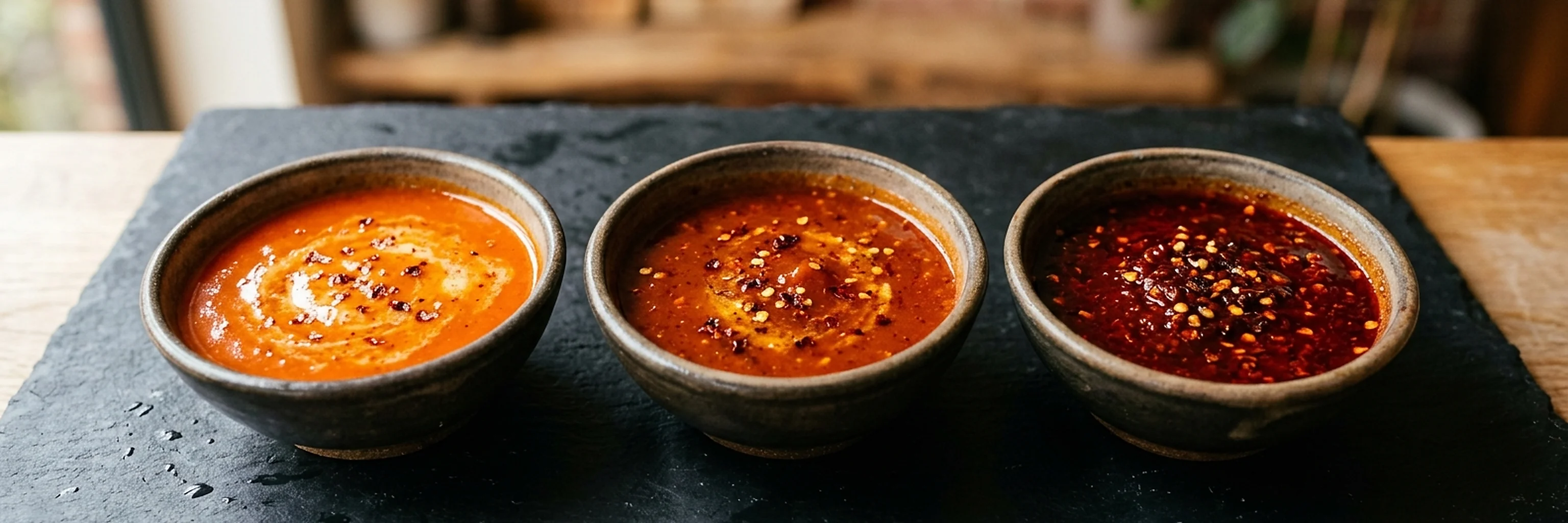
- Deeper color: The milk solid browning creates a golden-to-amber color. Buffalo sauce made with brown butter has a deeper, more amber-orange hue.
- More complex finish: Standard buffalo sauce flavor is linear - heat + tang + richness. Brown butter adds a longer, more layered finish.
- Slightly less dairy flavor: The browning process changes the dairy character from fresh-cream to toasted, which some people find more complex and others find less traditionally buffalo.
How to Brown Butter Correctly
Brown butter has a narrow window between properly browned and burned. The process:
- Use a light-colored saucepan (stainless steel, not non-stick dark pan) - you need to see the color change.
- Melt butter over medium heat, stirring frequently.
- The butter will foam (water boiling off), then the foam will subside.
- Watch for: the butter begins to turn golden yellow, then amber. You'll hear a slightly different sound (the water is gone, now just fat and milk solids).
- The milk solids at the bottom of the pan will appear as brown specks.
- Smell: a nutty, popcorn-like aroma replaces the clean butter smell. This is your indicator of perfect browning.
- Remove from heat immediately and pour into a separate bowl - residual heat in the pan will continue browning (and eventually burning) the butter if it stays in the hot pan.
Total time from melting to brown: approximately 3-5 minutes on medium heat. Watch constantly - the window between golden-brown and burned is about 30 seconds.
Ingredients
- 6 tablespoons unsalted butter
- 3/4 cup Frank's RedHot Original (or other cayenne hot sauce)
- 1/2 teaspoon garlic powder
- Pinch of kosher salt (taste first - hot sauce is already salted)
Method
- Place butter in a light-colored stainless steel saucepan over medium heat.
- Stir occasionally as butter melts, foams, and the foam subsides.
- Continue cooking, stirring more frequently, as the butter turns from yellow to golden to amber. Watch for brown specks forming at the bottom.
- When the butter is amber-colored and smells nutty (like hazelnuts or popcorn), remove immediately from heat.
- Pour brown butter into a heatproof bowl immediately - do not leave in the hot pan.
- Let brown butter cool for 2-3 minutes. It should be warm but not scorching.
- Whisk in Frank's RedHot. Whisk vigorously to emulsify - the emulsification works the same way as with regular melted butter.
- Add garlic powder. Taste and adjust salt.
- Use immediately or keep warm over a double boiler for up to 30 minutes.
Tips
- The sauce emulsifies best when the brown butter is still warm but not searing hot. If the butter is too hot, the vinegar in the hot sauce may steam aggressively - this is fine but splatter protection is advisable.
- Brown butter buffalo sauce breaks more easily than regular - keep it warm and serve immediately. It won't hold at room temperature as well.
- Use on wings, on grilled chicken, or as a finishing sauce for pan-seared chicken breasts.
When Brown Butter Buffalo Sauce Shines
Brown butter buffalo sauce isn't better in every application - it's situationally better:
- Best for: Finishing sauce on grilled chicken, pan-seared chicken breasts, or restaurant-quality wing presentations where you want to demonstrate extra technique.
- Good for: Buffalo chicken pasta (the nutty depth complements the creamy dairy elements), stuffed mushrooms with buffalo chicken filling.
- Neutral: Tossed wings - the brown butter's nuance can get lost when wings are eaten quickly at a party.
- Not ideal for: Buffalo dip or applications where the sauce is a background ingredient - the investment in browning the butter produces minimal payoff when the sauce is diluted by cream cheese or other dairy.
Why Brown Butter Emulsifies Differently
Brown butter has less water than regular melted butter (the browning process evaporates the remaining moisture) and the milk solids are now browned solids rather than suspended proteins. This changes the emulsification dynamics slightly - browned butter is more prone to breaking at lower temperatures than regular melted butter. Keep the sauce warm (not hot) during service, and re-emulsify with gentle whisking if it begins to separate.