Quick Answer
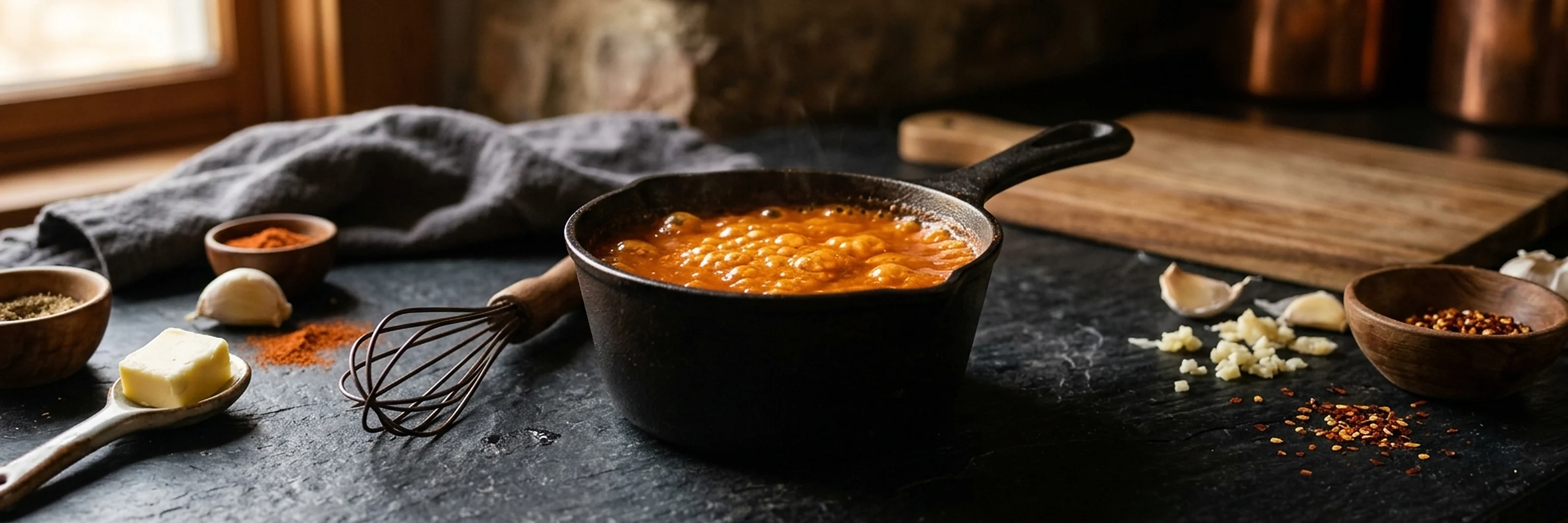
How do you make buffalo sauce?Melt 4 tablespoons unsalted butter over low heat. Pull the pan off heat and whisk in 1/2 cup Frank's RedHot Original. Add 1/2 tsp garlic powder and a dash of Worcestershire sauce. Whisk for 45 seconds until smooth and glossy. That's it. The only thing most recipes get wrong: they add hot sauce to boiling butter instead of warm butter, and the sauce separates. Pull it off heat first.
Buffalo sauce is the simplest recipe that the most people overcomplicate. Three ingredients, one pan, ten minutes. But the technique separates a sauce that glazes wings perfectly from one that slides off and puddles on the plate.
This guide gives you the recipe first, then explains why each step matters - so when you're scaling up for a party or adjusting heat levels, you know which variables you can change and which ones will break the sauce. For the full technical deep-dive into emulsification science and every ratio variant, the complete homemade buffalo sauce guide has everything.
The Classic Buffalo Sauce Recipe
Ingredients
- 1/2 cup Frank's RedHot Original hot sauce
- 4 tablespoons (1/2 stick) unsalted butter, cut into pieces
- 1/2 teaspoon garlic powder
- 1/2 teaspoon Worcestershire sauce
- Salt to taste (often not needed - Frank's is already salted)
Method
- Add butter to a small saucepan over low heat. Melt slowly - don't rush with high heat. You want it liquid and warm (around 130°F), not hot or bubbling.
- Remove pan from heat. This is critical. Let the butter sit off the burner for 30 seconds.
- Pour in Frank's RedHot while whisking constantly. Use a tight circular wrist motion for 45 seconds. The sauce will turn from clear/yellow to an opaque orange-red.
- Return to the lowest heat setting. Whisk for another 60 seconds while the sauce warms. It will become glossy and slightly thickened.
- Add garlic powder and Worcestershire. Stir to combine. Taste - adjust with a tiny pinch of salt, more hot sauce for heat, or a small knob of butter for richness.
- Use immediately, or hold at the lowest heat setting while stirring occasionally.
Tips
- The sauce should be glossy and coat the back of a spoon. If it looks greasy or separated, take off heat and whisk vigorously - it usually recovers.
- For larger batches, a blender handles emulsification better than a whisk.
- This ratio (2:1 hot sauce to butter) is the medium-heat standard. See the heat adjustment section below to go hotter or milder.
Why Each Ingredient Matters
Frank's RedHot Original - Not Just Any Hot Sauce
Frank's RedHot Original is vinegar-dominant - aged cayenne peppers + distilled white vinegar - with a modest 450 Scoville heat units. That vinegar is the functional ingredient in buffalo sauce: it provides the acidic, water-based component that creates the emulsion with butter fat. It also delivers the sharp, tangy bite that makes the difference between hot sauce and buffalo sauce.
You can swap Frank's for any vinegar-based cayenne hot sauce - Crystal, Louisiana Brand, Texas Pete. Don't use thick sauces (Sriracha, Cholula), tomato-based sauces, or anything labeled "wing sauce" that's pre-mixed with butter. You want the base hot sauce so you control the ratio.
Unsalted Butter - Fat and Richness
Butter provides the fat that makes buffalo sauce thick, coating, and rich. Unsalted gives you control over the final salt level since Frank's already contains sodium. Use real butter - not margarine, not cooking spray, not olive oil. The milk solids in real butter act as an emulsifier that helps bond the fat with the water-based hot sauce.
European-style higher-fat butter (Kerrygold, Plugrá) makes a noticeably richer sauce with a silkier texture. It costs a bit more, but if you're using the sauce for a showpiece batch of wings, it's worth it.
Garlic Powder and Worcestershire - The Depth Layer
These aren't optional decoration. Garlic powder adds savory depth that rounds out the sharpness of the vinegar. Worcestershire contributes umami - fermented anchovies, tamarind, and molasses - that makes the sauce taste more complex without any single ingredient standing out. Skip either one and the sauce tastes flat, one-dimensional.
Don't use fresh garlic here. Fresh garlic doesn't incorporate smoothly into an emulsified sauce and can turn bitter at low cooking temperatures. Garlic powder distributes evenly and holds its flavor.
Adjusting Heat Levels
The classic 2:1 ratio (hot sauce to butter) lands at medium heat - noticeable but not aggressive, appropriate for most guests and most applications. Here's how to adjust:
Going Hotter
Don't just add more hot sauce - at ratios above 3:1 the emulsion starts to fail. Instead, add 1/4 teaspoon cayenne pepper powder after emulsifying. Or stir in 1-2 teaspoons of a hotter sauce (habanero hot sauce works well) in addition to the Frank's. This lets you boost capsaicin without throwing off the butter-to-liquid ratio.
Going Milder
Shift toward a 1:2 ratio (hot sauce to butter) for a mild, rich sauce. Or add 1-2 tablespoons of honey to the standard recipe - it rounds off the vinegar heat and produces a honey buffalo that's popular for dipping. For a full chart of every ratio, the buffalo sauce ratio guide breaks down each option.
Serving and Holding During Service
Tossing wings in buffalo sauce creates a specific problem: the sauce continues to heat from the wings, the emulsion continues to evolve, and if you're not careful the sauce breaks and pools on the plate. Three practices prevent this:
- Toss in a bowl, not the pan. Transfer wings to a large bowl, pour sauce over, and toss immediately. The bowl keeps temperature even and lets you coat every wing.
- Don't oversauce. Wings should be coated, not swimming. Too much sauce on hot wings causes the fat to break free as the sauce heats. Use enough to coat - about 2-3 tablespoons per pound of wings.
- Hold sauce separately if possible. For parties, keep a small pot of buffalo sauce on the lowest heat setting and toss wings in batches. Sauce held too long on high heat will separate.
Making Buffalo Sauce Ahead of Time
Homemade buffalo sauce keeps refrigerated for up to two weeks. In the fridge, the butter solidifies - this is normal. To reheat, transfer to a small saucepan over low heat and whisk constantly as it warms. The emulsion returns within 90 seconds.
For game-day prep: make the sauce the night before, refrigerate, and reheat while the wings are cooking. This actually gives you better control - you're not making sauce and cooking wings simultaneously.
Don't microwave buffalo sauce. Uneven microwave heat destroys the emulsion in the same way that boiling butter does - the fat separates and doesn't come back together cleanly.
Watch for Separation
If your reheated sauce looks oily with a red liquid pooling separately, it's separated. Don't discard it - take it off heat, let it cool to 110-120°F, and whisk vigorously. For persistent separation, add one teaspoon of cold butter and whisk it in as a rescue emulsifier. The separation fix guide covers every scenario.