Quick Answer
Which is better - buffalo sauce or ranch dressing with wings?Depends entirely on what you want. Buffalo sauce is the coating and the flavor - it goes on the wings. Ranch is the cooling dipping component - it goes on the side. They serve different functions and aren't actually competitors. If you're talking about pure dipping (no coating), buffalo sauce wins for flavor intensity; ranch wins for creaminess and cooling heat. For an opinion on the cultural debate: blue cheese is the original Buffalo accompaniment, ranch became popular nationally because it's more universally available and milder.
The buffalo sauce vs. ranch debate is one of those food arguments where both sides are talking past each other. Buffalo sauce advocates mean "don't dilute the heat with creamy dressing." Ranch advocates mean "I need a cooling dip and ranch is accessible." Neither is wrong - they're describing different preferences for different functions.
This guide covers what both products actually are, how they differ nutritionally and functionally, the history of how ranch became the default wing accompaniment in American restaurants, and where each performs better. Understanding the relationship between buffalo sauce and ranch also matters for cooking - ranch appears as an ingredient in buffalo chicken dip for structural reasons, not just flavor.
What Each Actually Is
Buffalo Sauce
Buffalo sauce is an emulsified condiment made from cayenne pepper hot sauce (most commonly Frank's RedHot) and butter, at a ratio of approximately 2:1. The butter emulsifies into the hot sauce to create a stable, glossy, coating sauce. It's applied to wings and other food as a coating - the food is tossed in the sauce before serving, not served alongside it. The defining characteristics: tangy (from vinegar), mildly hot (cayenne), rich (butter fat), and orange-red in color.
Ranch Dressing
Ranch dressing is a creamy emulsion of buttermilk, mayonnaise, and herbs/seasonings (typically garlic, onion, dill, parsley, chives). It was invented by Plumas County, California rancher Steve Henson in the 1950s and popularized nationally after Hidden Valley Ranch started commercial production in the 1970s. It's the most popular salad dressing in the United States by volume sold. Its defining characteristics: creamy, mildly tangy (buttermilk and mayonnaise), herby, and cooling on the palate.
Ingredients Side by Side
Buffalo Sauce vs. Ranch Dressing - Ingredients
| Characteristic | Buffalo Sauce | Ranch Dressing |
|---|---|---|
| Primary fat source | Butter (emulsified) | Mayonnaise + buttermilk |
| Acid source | Vinegar (in hot sauce) | Buttermilk lactic acid |
| Heat/spice | Cayenne pepper | None |
| Herbs/aromatics | Garlic powder, paprika | Dill, parsley, chives, garlic |
| Texture | Thin, glossy coating sauce | Thick, creamy, opaque |
| Color | Orange-red | White/cream |
| Primary flavor | Tangy, hot, savory | Creamy, herby, mild |
Flavor Profiles and What They Do to Food
Buffalo sauce is an active flavor component - it coats food with its own distinctive taste. When a wing is tossed in buffalo sauce, the sauce penetrates the surface slightly and seasons every bite. The heat, tang, and richness of the sauce become part of the dish itself.
Ranch dressing is a passive complement - it's cooling, creamy, and mild enough to not compete with the food's flavor. A celery stick dipped in ranch doesn't taste like ranch; it tastes like celery cooled by cream. Ranch's role with wings is to provide a respite from the heat - the fat in the mayonnaise and buttermilk absorbs and temporarily neutralizes capsaicin on your mouth receptors, giving a break between bites.
This is why the two aren't really competitors: buffalo sauce does the heavy flavor lifting on the wing; ranch resets your palate for the next wing. They work together.
Nutrition Comparison
Buffalo Sauce vs. Ranch Dressing - Nutrition (per 2 tablespoons)
| Nutrient | Buffalo Sauce (Frank's) | Ranch (Hidden Valley) |
|---|---|---|
| Calories | 25 | 140 |
| Total Fat | 2g | 14g |
| Saturated Fat | 0g | 2g |
| Sodium | 460mg | 260mg |
| Carbohydrates | 1g | 2g |
| Protein | 0g | 1g |
The nutrition comparison shows why they're different products. Buffalo sauce is a high-sodium, low-calorie condiment - almost entirely water, vinegar, pepper, and a small amount of emulsified fat. Ranch dressing is a high-fat, moderate-calorie condiment - mostly fat from mayonnaise and buttermilk.
If you're monitoring calories, buffalo sauce is dramatically lower in calories per serving. If you're monitoring sodium, ranch is significantly lower. Neither is a "healthy" condiment in the traditional sense, but they represent different nutritional trade-offs.
The Cultural Debate: Ranch vs. Blue Cheese
The original Anchor Bar buffalo wing recipe was served with blue cheese dressing (or just celery), not ranch. Blue cheese - chunky, pungent, creamy - was the original accompaniment and is still used at the Anchor Bar in Buffalo, NY. The blue cheese provides a rich, funky counterpoint to the tangy buffalo heat.
Ranch became the dominant wing accompaniment nationally for straightforward reasons: it's milder and more universally palatable. Blue cheese has a divisive, acquired taste - many people (especially those who didn't grow up eating it) find it off-putting or too strong. Ranch has no such polarizing quality. When restaurant chains began putting wings on menus in the 1980s and 1990s for national audiences, ranch was the safer choice that appealed to more customers.
The result is a regional divide: Buffalo, NY and surrounding upstate New York tends toward blue cheese. The rest of the United States tends toward ranch. Neither group is wrong about their preference - they're expressing what they grew up with and what they find most enjoyable.
For Wing Purists
If you've only ever had wings with ranch and want to try the original combination, make a proper blue cheese dressing: crumbled Roquefort or Gorgonzola stirred into equal parts mayonnaise and sour cream, a splash of lemon juice, salt, black pepper. Serve cold alongside hot wings. The contrast between the funky, creamy blue cheese and the sharp buffalo sauce is different from ranch - more complex, more assertive, and more authentically Buffalo.
Where Each Works Best
Buffalo Sauce Wins
- As a wing coating - the sauce bonds to the fried or baked surface
- In dips (buffalo chicken dip uses it as the primary flavor driver)
- On pizza, flatbread, nachos - anywhere you want bold, hot flavor
- As a marinade base for grilled chicken
- When calorie count matters more than fat content
Ranch Wins
- As a palate cleanser alongside hot wings
- As a dipping sauce for raw vegetables with wings
- On salads where the heat of buffalo sauce would be out of place
- For those who can't handle heat - ranch on the side provides an exit
- In wing recipes where ranch is an ingredient (dips, pasta, salads)
Using Both Together
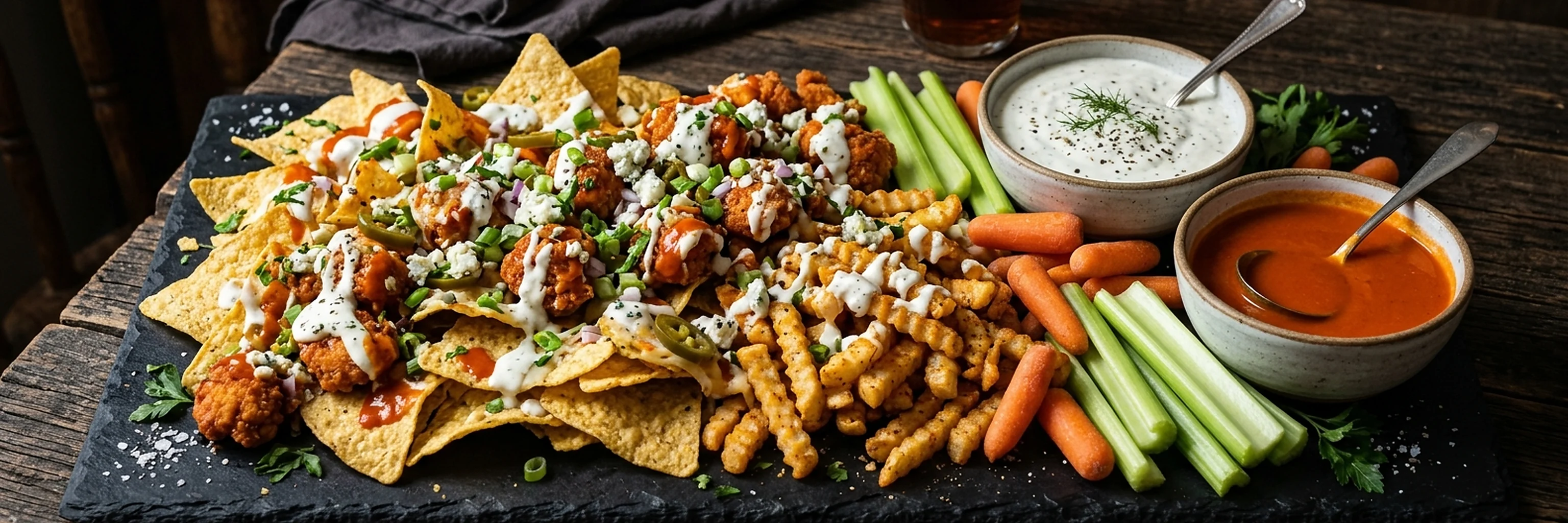
The most sophisticated approach is using both: buffalo sauce on the wings, ranch (or blue cheese) on the side. Each does its job, the contrast between the two makes both better, and guests with different heat tolerances have options.
Beyond wing accompaniment, ranch appears as an ingredient inside buffalo chicken dip - not just alongside it. In that recipe, ranch provides dairy fat and herby flavor to balance the buffalo sauce, playing a structural role rather than a serving role.
Similarly, some homemade buffalo sauce recipes incorporate a tablespoon of ranch powder (the dry mix) into the sauce for additional depth - the herbs round out the simple vinegar-butter-cayenne profile without making the sauce taste like ranch dressing.