Quick Answer
How do you make curry buffalo sauce?Bloom 1 teaspoon of curry powder in the butter before adding the hot sauce - this is the key step. Blooming means heating curry powder in fat for 60-90 seconds to activate and deepen the spice blend's flavor compounds through the Maillard reaction. Then add Frank's RedHot and complete the standard buffalo sauce emulsification. Without blooming, raw curry powder tastes dusty and flat in the sauce. The result: a sauce with buffalo's tangy heat base plus curry's complex warm spice character - a genuine fusion that works especially well on cauliflower, chickpeas, and chicken prepared in Indian-inspired formats.
Why Curry and Buffalo Sauce Work Together
Buffalo sauce and curry sauce are both built on capsaicin heat, acidity, and fat - the same three structural elements, expressed through different spice vocabularies. Buffalo sauce delivers heat via cayenne capsaicin, acidity via vinegar in the hot sauce, and fat via butter emulsification. Curry delivers heat via chili peppers (and sometimes black pepper), a complex aroma via a spice blend, and fat via ghee or oil. The underlying architecture is compatible.
The challenge is balance: curry's complex spice blend (cumin, coriander, turmeric, fenugreek, and more, depending on the blend) can overwhelm buffalo sauce's relatively simple flavor profile. The goal is to use curry as a supporting complexity rather than a competing flavor - not "curry sauce with some Frank's in it" but "buffalo sauce with curry warmth underneath."
The right ratio is approximately 1 teaspoon of curry powder per 1/2 cup of Frank's RedHot - enough to be clearly present but not enough to overpower the familiar buffalo character. More detail in the buffalo sauce ingredients guide.
Which Curry Powder to Use
Curry Powder Types for Buffalo Sauce
| Curry Powder Type | Heat Level | Dominant Notes | Best For |
|---|---|---|---|
| Mild curry powder (standard) | Low | Turmeric, coriander, cumin | Starting point - most approachable |
| Best: Madras curry powder | Medium | Chili, cumin, curry leaf | Best balance of heat and flavor depth |
| Hot curry powder | High | Chili, black pepper, mustard | Heat-seekers; can overpower buffalo base |
| Garam masala | Very low | Cardamom, clove, cinnamon | Aromatic depth; minimal heat - good as accent |
| Thai yellow curry paste | Medium | Lemongrass, galangal, turmeric | More complex; use 1/2 tsp paste vs. 1 tsp powder |
Madras curry powder is the best choice for buffalo sauce because it has a meaningful chili component (which complements rather than conflicts with buffalo's cayenne heat), good aromatic depth from the spice blend, and less sweetness than standard mild curry powder. The turmeric in all curry powders also adds a golden color to the sauce - curry buffalo sauce has a distinctive orange-gold hue that's visually appealing.
Ingredients
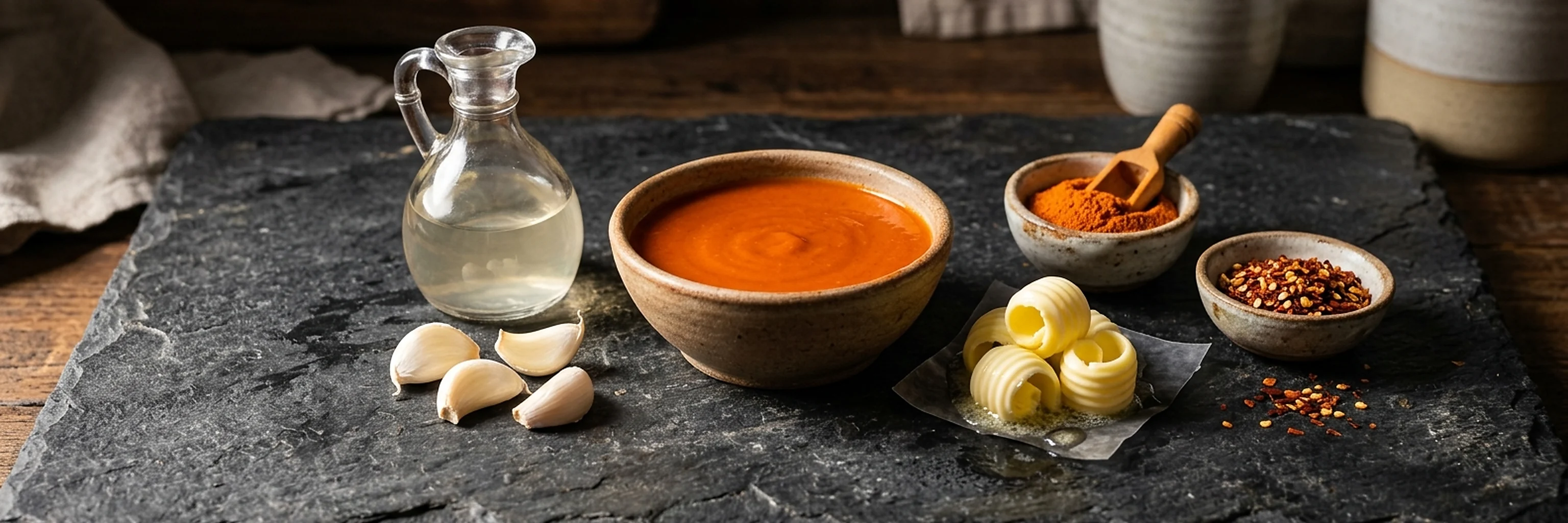
- 1/2 cup Frank's RedHot Original
- 3 tablespoons unsalted butter
- 1 teaspoon Madras curry powder (or mild curry powder)
- 1/4 teaspoon garlic powder
- 1/4 teaspoon ground cumin
- Pinch of salt
- Optional: 1 teaspoon honey (rounds out spice blend's rough edges)
- Optional: squeeze of lemon juice (brightens the curry character)
Method
- Heat a small saucepan over medium-low heat. Add butter and melt completely.
- Add curry powder, garlic powder, and cumin directly to the melted butter. Stir and cook for 60-90 seconds, stirring constantly. The butter will turn golden-orange and the spice blend will become fragrant. This is blooming - the fat solubilizes aromatic compounds and Maillard chemistry deepens the spice flavors. Don't skip this step.
- Add Frank's RedHot to the bloomed spice butter. Stir to combine. Bring to a gentle simmer for 2 minutes, stirring occasionally.
- Remove from heat. If the sauce has separated (normal), whisk vigorously for 30 seconds to re-emulsify. Add honey and lemon juice if using.
- Taste and adjust: more curry powder for more spice complexity (add and bloom separately in a bit of butter for best results); more Frank's for more heat and acidity.
- Use immediately or refrigerate up to 5 days. The curry flavor deepens slightly after the first day.
Tips
- Blooming in butter is essential, not optional. Raw curry powder added to hot sauce tastes flat and dusty. The blooming step transforms the spice blend's flavor through Maillard chemistry - fat-soluble aromatic compounds activate and deepen. The 60-90 second timing is important: less than 30 seconds is insufficient; more than 2 minutes risks burning.
- For a richer, more complex sauce: sauté 1/4 cup of finely minced onion in the butter before adding the curry powder. The onion's natural sugars caramelize slightly, adding sweetness and depth. This adds 5 minutes to prep but produces a noticeably more layered sauce.
- Curry buffalo sauce intensifies in flavor as it sits - if you make it more than 24 hours ahead, reduce the curry powder by 25% to account for this development.
The Color Tells You Something
Turmeric (a component of all curry powders) contains curcumin, which gives curry its distinctive golden-yellow color. When you bloom curry powder in butter, you'll see the butter turn bright orange-gold almost immediately - this color change is a visual indicator that the fat-soluble curcumin and other aromatic compounds are activating. A well-bloomed curry butter should be vivid orange-gold, not pale yellow. If the color is weak, the blooming was insufficient and the flavor will be flat. Trust the color as a doneness indicator for this step.
Applications for Curry Buffalo Sauce
The curry character expands the applications beyond traditional American wing contexts:
- Buffalo cauliflower with an Indian twist: Curry buffalo cauliflower served over basmati rice with yogurt raita - the cauliflower preparation from the buffalo cauliflower guide with curry buffalo sauce instead of standard, served in an Indian-inspired context rather than an American one.
- Chicken wings: The classic application. The curry complexity works especially well with blue cheese dressing - the blue cheese's tang, the buffalo heat, and the curry warmth create an interesting three-layer flavor experience.
- Chickpea applications: Toss roasted chickpeas in curry buffalo sauce for a snack or topping. Chickpeas absorb the sauce well and the protein makes it a satisfying appetizer.
- Flatbread: Curry buffalo chicken flatbread with yogurt sauce instead of ranch, topped with fresh cilantro and pickled red onions - a more globally inspired version of the buffalo chicken flatbread.